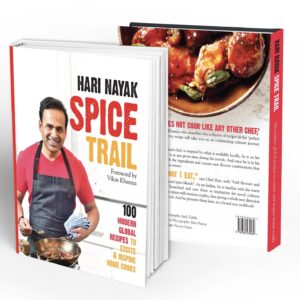
During an earlier visit to Four Seasons Resort Maldives at Kuda Huraa, time spent with New York–based chef Hari Nayak—across a masterclass, a quiet stretch out at sea, and unhurried conversation—offered a revealing sense of both method and temperament. The precision is evident; what lingers is something rarer: an instinctive humility that tempers craft with restraint. His food reflects that balance—layered, nuanced, yet never overworked—holding on to a clarity of flavour that feels increasingly deliberate. That clarity can perhaps be traced back to his hometown Udupi, renowned for the distinctive culinary philosophy of the 13th-century Krishna Math. Nayak’s work continues to draw from that lineage, even as it moves fluidly across geographies. The author of several cookbooks, including Spice Trail—with a foreword by Vikas Khanna—he translates regional Indian idioms without diluting their core.
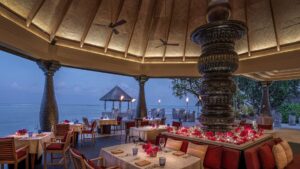
Baraabaru at Four Seasons Resort Maldives at Kuda Huraa
From May 11 to 17, 2026, Nayak returns to Baraabaru for a special residency. In this conversation with The Luxury Chronicle, he speaks with measured candour on origins, evolution, and the discipline of keeping flavour honest.
Neelima Agrawal – What makes your residency at Four Seasons Resort Maldives at Kuda Huraa particularly special for you?
Chef Hari Nayak – The Maldives is a magical place to cook. You’re surrounded by incredible seafood and tropical produce. For me it also feels personal because I grew up on the west coast of India, where the food is very connected to the sea. At Baraabaru we are able to blend that coastal Indian sensibility with the ingredients of the Maldives. Working closely with Chef Kishan Singh and the team there has been a wonderful collaboration. It feels less like a guest appearance and more like cooking with a team who share the same love for authentic flavors and high-quality culinary experiences.
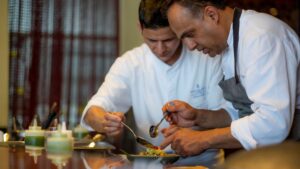
Chef Kishan Singh and Chef Hari Nayak at Four Seasons Kuda Hura
Your cooking often balances authenticity with innovation. How do you reinterpret traditional Indian dishes without losing their cultural identity?
For me the soul of a dish always comes from its original flavors. The spices, the balance of sour, heat, sweetness, and the cooking techniques are what define the culture of the dish.
Innovation usually comes in how you present it, lighten it, or adapt it to modern local ingredients. Sometimes I might use a different texture or ingredient or a global technique, but the core flavor profile remains very Indian. If you close your eyes and taste it, it should still feel familiar. I always say the goal is not to change the dish completely, but to let it evolve.
One standout dish is the whole baked lobster with coconut turmeric sauce and lemon rice. What story or inspiration lies behind this creation?
That dish draws inspiration from two things: the seafood curries of Kerala and the simple lemon rice I grew up eating. When you’re in the Maldives, the seafood is extraordinary, and fresh grilled lobster by the sea feels almost magical. The idea was to take something luxurious like whole lobster and pair it with very comforting, familiar coastal flavors. The lemon ice adds a fresh contrast and a little surprise on the plate. It cuts through the richness and makes the dish feel light and bright, which works beautifully in a tropical setting.
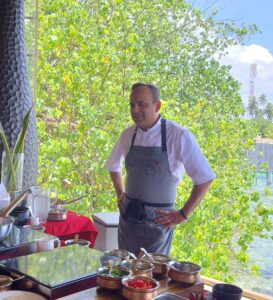
Chef Hari Nayak’s Master Class in progress at Burabbaru, Four Seasons Maldives Kuda Huraa in 2024
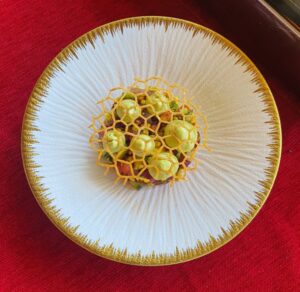
Master Class at Barabaaru
You are also introducing playful elements like Gulab jamun crème Brulé. How important is experimentation and cross-cultural technique in modern Indian cuisine?
I think experimentation is essential for a cuisine to move forward. Indian cuisine has always evolved through influences, migration and regional exchange. Using a popular dessert and technique like crème Brulé with a traditional Indian sweet Gulab Jamun is simply another way of telling that story. The flavors remain Indian, but the format becomes familiar to a global audience. It allows people who may not know Indian desserts to experience something recognizable yet new. The key is to keep the flavors authentic while having a little fun with the format.
Regional Indian food remains vastly underrepresented internationally. Which lesser-known regional cuisine deserves greater global attention?
 India’s regional diversity is incredible and still not fully explored internationally, though it has evolved quite a bit over the last few years. I’ve been focusing a lot on the coastal regions of India, which deserve much more attention, particularly Kerala, Goa, and the Konkan coast. The use of coconut, spices, seafood, and souring agents like kokum creates very unique flavor profiles. I’m also very fascinated by the food of Rajasthan and Northeast India, which have amazing ingredients and very clean, vibrant flavors. And of course, Bengali cuisine, which has a deep sophistication when it comes to seafood, mustard, and subtle spice balance. There are still many stories from India’s regional kitchens waiting to be told.
You’ve written cookbooks, opened restaurants internationally, and championed Indian cuisine globally. What continues to inspire you creatively today?
Travel and curiosity keep me inspired. Every time I go back to India, I discover something new. A lesser-known regional dish, a technique from a home cook, or an ingredient I hadn’t paid attention to before. Even after cooking for many years, Indian cuisine still surprises me. I learn something new every day. I’m also inspired by younger chefs and in my team who are exploring their own regional roots. It reminds me that our cuisine is constantly evolving, and there are always new stories to tell through food.
If guests experience only one dish during your residency at Baraabaru, which one would you want them to try—and why?
I would say the Goan cafreal fish, banana leaf wrapped fillet, coconut turmeric reduction, and cassava dumplings. You have incredible Maldivian fresh caught fish paired with very soulful coastal Indian flavors from Goa. It’s cooked in a unique way and presented with ingredients and components that are quite different from the traditional way it would be prepared in Goan homes. It’s luxurious, comforting, and rooted in tradition at the same time. And of course, when you’re sitting over the lagoon in the Maldives eating this, it’s a pretty unforgettable experience.

Fishing expedition -Chef Hari Nayak and Neelima Agrawal at Four Seasons Maldives
Indian cuisine is incredibly diverse, yet globally it is still often represented by a narrow set of dishes. What do you think the world still misunderstands about the true depth of Indian regional cooking?
Many people outside India still think of Indian cuisine as just Punjabi curries and a handful of dishes like samosa, naan and tikka masala. In reality, Indian food is incredibly regional. The ingredients, cooking techniques, and flavors change dramatically from one state to another. In some regions the food is very coconut-driven; in others mustard dominates, cooking over wood fire, and in others fermentation and pickling play a big role. What I hope people discover over time is that Indian cuisine is not one cuisine. It’s a collection of many culinary traditions, shaped by global exchanges, each with its own identity and history.