Art history often finds its most compelling voice in those who approach it with both rigour and curiosity—qualities that define the writing of Abha Mehta. With a keen interest in researching landmark works and unpacking their layered meanings, Mehta brings a considered, interpretive lens to masterpieces such as Guernica by Pablo Picasso. In this piece, she moves beyond surface readings to situate the work within its historical, artistic, and emotional contexts, offering a nuanced exploration of one of the most powerful anti-war images of the 20th century.
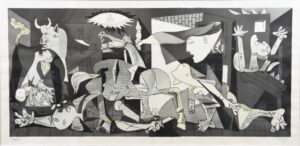
Guernica by Pablo Picasso. 1937
By Abha Mehta
“When I was a child, I painted like Raphael, but it took me a lifetime to learn to paint like a child,” said Pablo Picasso—a remark that finds its fullest expression in Guernica. Painted in 1937, the work remains one of the most searing visual indictments of war ever created a monumental canvas where anguish is stripped to its rawest, most elemental form.
The trigger was immediate and brutal. On 26 April 1937, during the Spanish Civil War, German warplanes bombed the Basque town of Guernica for over three hours, decimating much of its population. The attack, carried out in support of General Franco, shocked the world. Picasso, then living in Paris and already commissioned to produce a mural for the Spanish Republic’s Pavilion at the 1937 World Fair, found his subject. What followed was an extraordinary act of artistic urgency: within weeks, working from newspaper photographs of the attack, he produced a vast monochromatic canvas—over 25 feet x 11 feet—that transformed reportage into myth.
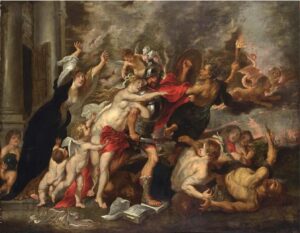
An Allegory showing the effects of war (‘The Horrors of War’) – by Peter Paul Rubens 1638, currently displayed at the National Gallery, London
Despite its immediacy, Guernica is not reportage. Picasso avoids literal depiction; there are no planes, no bombs, no identifiable geography. Instead, he constructs an allegory—one that draws from a deep art historical lineage. The influence of Rubens ‘An Allegory showing the Effects of War (‘The Horrors of War’) painted in 1638, is evident in its conceptual framing: war not as event, but as force—inevitable, consuming, and resistant to reason. The painting depicts Mars, the God of war, being pulled towards war by Alecto (one of the furies) and even the efforts of Venus the Goddess of love will not stop him.
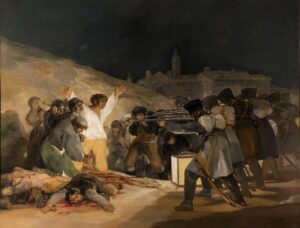
The Third of May 1808 – by Francisco Goya
Likewise, echoes of Goya’s The Third of May 1808 surface in its emotional register, where suffering is both individual and collective, immediate and eternal. Goya’s The 3rd of May 1808 depicts a nightmare massacre. The pose of the central character is reminiscent of the screaming woman. And in both the paintings we can see signs of stigmata on the hand of the soldier which is also sign of the ultimate sacrifice as in the case of Jesus Christ.
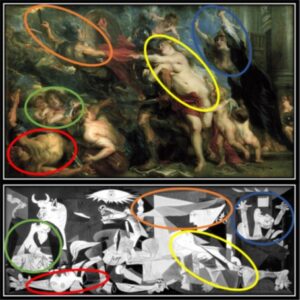
The comparison between Ruben’s ‘Horrors of War’ and Picasso’s ‘Guernica’ showing the effects of war
Yet Picasso’s language is unmistakably modern. The canvas is rendered entirely in black, white, and grey—an aesthetic choice that evokes the starkness of newsprint while amplifying the emotional severity of the scene. Colour, which might have aestheticised the violence, is deliberately withheld.
At first glance, the composition appears chaotic—figures collide, limbs fracture, space collapses. But beneath this apparent disorder lies a rigorous structure. The painting is organised into three vertical groupings, anchored by a central triangular axis of light. This underlying geometry stabilises the visual field, allowing the chaos to unfold within a controlled framework.
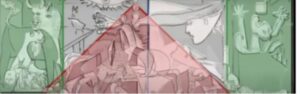
The classical organisation of the characters in the painting by Picasso
Within this structure, Picasso deploys a cast of symbolic figures. To the left stands the bull—dark, impassive, and confrontational. It is the only figure that meets the viewer’s gaze directly, its stillness contrasting sharply with the surrounding hysteria. Beneath it, a grieving mother cradles her dead child, her mouth open in a silent, endless scream. At the centre, a wounded horse collapses in agony, its body pierced, its form distorted. Picasso himself associated the horse with the innocent, brutalised, yet enduring people.
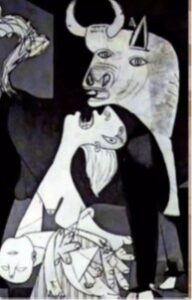
The Bull and the grieving mother
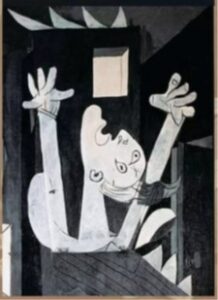
The burning woman is entrapped by fire, her right hand suggesting the shape of an airplance
Scattered across the foreground lies the dismembered body of a fallen soldier. His broken sword suggests defeat, yet from it emerges a small flower—a fragile but persistent symbol of hope. Nearby, a fractured dove—traditionally an emblem of peace—appears barely intact, its presence more elegiac than reassuring.
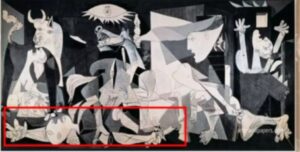
The dismembered body of a fallen soldier. His broken sword suggests defeat, yet from it emerges a small flower
Light, too, becomes a charged symbol. Overhead, a stark electric bulb glares down, its form resembling an all-seeing eye. Often interpreted as a reference to modern technology—the very machinery that enabled such destruction—it also carries a linguistic echo: the Spanish word bombilla (light bulb) quietly invokes bomba. Below it, a woman holds an oil lamp, its softer glow offering a counterpoint—a more human, almost spiritual illumination. Between these two sources of light lies the tension between mechanised violence and fragile hope.
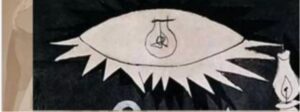
The light bulb is the single image of 20th century technology and has multiple meanings. Perhaps it is the eye of God overlooking the madness of war?
To the right, figures burn, flee, and collapse. A woman trapped in a blazing building stretches skyward in desperation; another, wounded and crawling, looks toward the lamp as if drawn to its promise. These are not portraits but archetypes—embodiments of fear, pain, and helplessness.
Crucially, Guernica resists a single, fixed interpretation. Picasso himself rejected definitive readings, insisting instead on ambiguity. “Art is a lie that makes us realise the truth,” he said. It is precisely this openness that grants the work its enduring power. While rooted in a specific historical moment, it transcends it—becoming a universal language of suffering. The ambiguity and lack of specific historical details make the painting timeless.
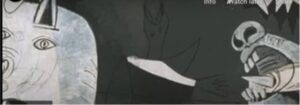
Between the bull and the horse, we can just about see a dove, normally a representation of peace.
Its afterlife only reinforces this. Exhibited at the Paris Expo in 1937, the painting gained renewed resonance during the Second World War. Picasso refused to allow it to return to Spain while Franco remained in power; it spent decades in exile, its meaning evolving with each new conflict. A tapestry version at the United Nations became an emblem of global conscience. In 2003, the then Secretary of State Colin Powell delivered a televised speech at the UN- arguing for war on Iraq. In a form of blatant censorship, the Bush administration requested that the tapestry be covered up. It is thought that the George W. Bush administration deemed the painting inappropriate as a backdrop for a declaration of war.
Nearly a century later, Guernica feels less like a historical artefact and more like a mirror. No work of art in the 20th century has left its mark in quite the way Guernica has. It has become the universal symbol of indiscriminate slaughter, and it has helped to shape a century. The lessons of Guernica, of universal suffering have still not been learnt and that is why Guernica is still as important today as it was in 1937. Guernica is not just contemporary art, it is history. The message of the work goes further than just the bombing of the town of Guernica. It is a message about war and violence in general. Picasso always said he was apolitical. Often considered a symbol of universal suffering, Picasso’s Guernica painting shows that even if we are apolitical, everyone has a duty to protest violence.
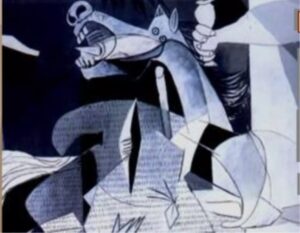
The screaming horse at the center is collapsing from his gaping wound but its head remains upwards as it struggles to live. A “hidden” image formed by the horse appears- the horse’s nostrils and upper teeth can be seen as a human skull facing left and slightly downward.
It is said that when a German officer visited him, in his studio in Nazi occupied Paris, he saw a photograph of Guernica on his wall. He asked Picasso: “Did you do that?”
Picasso replied: “No, you did. “